Interaction goes
industrial
How AR, AI, and Spatial Computing are Changing the Way Companies Collaborate Inside and Out
| Illustrations: Matt Chinworth
Strap on your digital hard hat because today you’re going to work in the industrial metaverse.
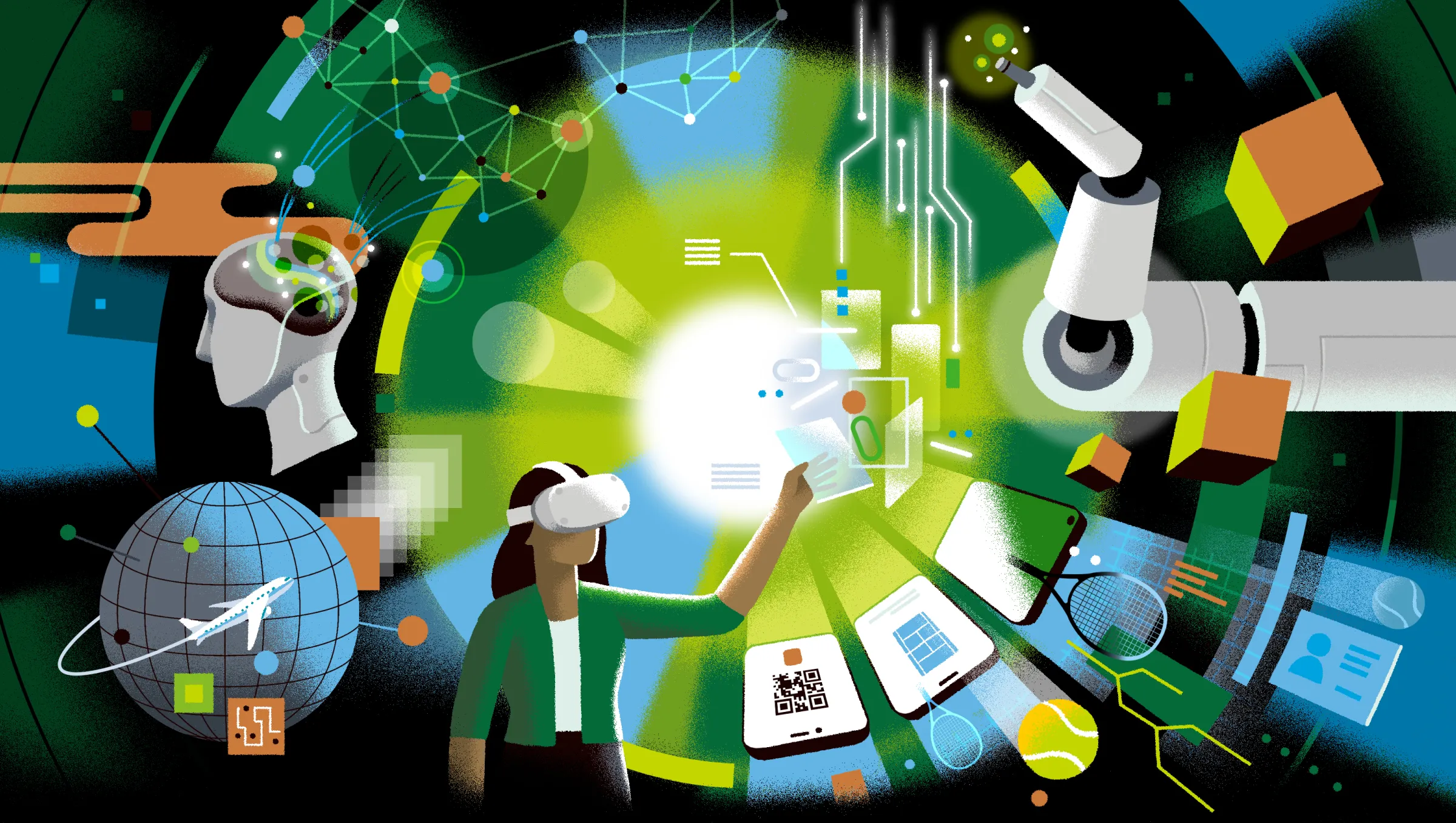
No longer the stuff of science-fiction or limited to the consumer sphere, augmented reality, artificial intelligence, and spatial computing — all made possible by the twin powers of 5G and cloud computing — are already upending the way companies communicate internally and with their clients.
These terms are no longer just buzzwords; their applications and impacts are increasingly mission-critical to the business models of modern companies.
“More often than not, novel technologies spark excitement with early adopters and consumers before quietly receding from the public eye,” says Deloitte’s Tech Trends 2024, our inspiration for this digital journey. “However, they then reappear months or years later as productive business tools.”
And they certainly are productive. In fact, revenue driven by the industrial metaverse is now projected to reach nearly US $100 billion by 2030, far outpacing the estimated value of the metaverse for the consumer (US $50 billion) and enterprise (US $30 billion) segments, according to Deloitte’s latest report.
We also know that phrases like “collaborative digital spaces” can be a bit abstract even for the most tech-savvy teams. That’s why we’re going to put you in the driver’s seat of three companies at the forefront of the industrial metaverse.
You’ll see how these organizations, with the deep technology experience of Deloitte, are harnessing emerging technologies for such innovative use cases as designing an EV factory in Hungary with spatial computing to getting citizens back on the tennis courts of Great Britain with AI and AR.
So punch that virtual clock and get ready for a thrilling day at the office.
Manufacturing Made Modern
of a new EV plant
to redesign the factory floor
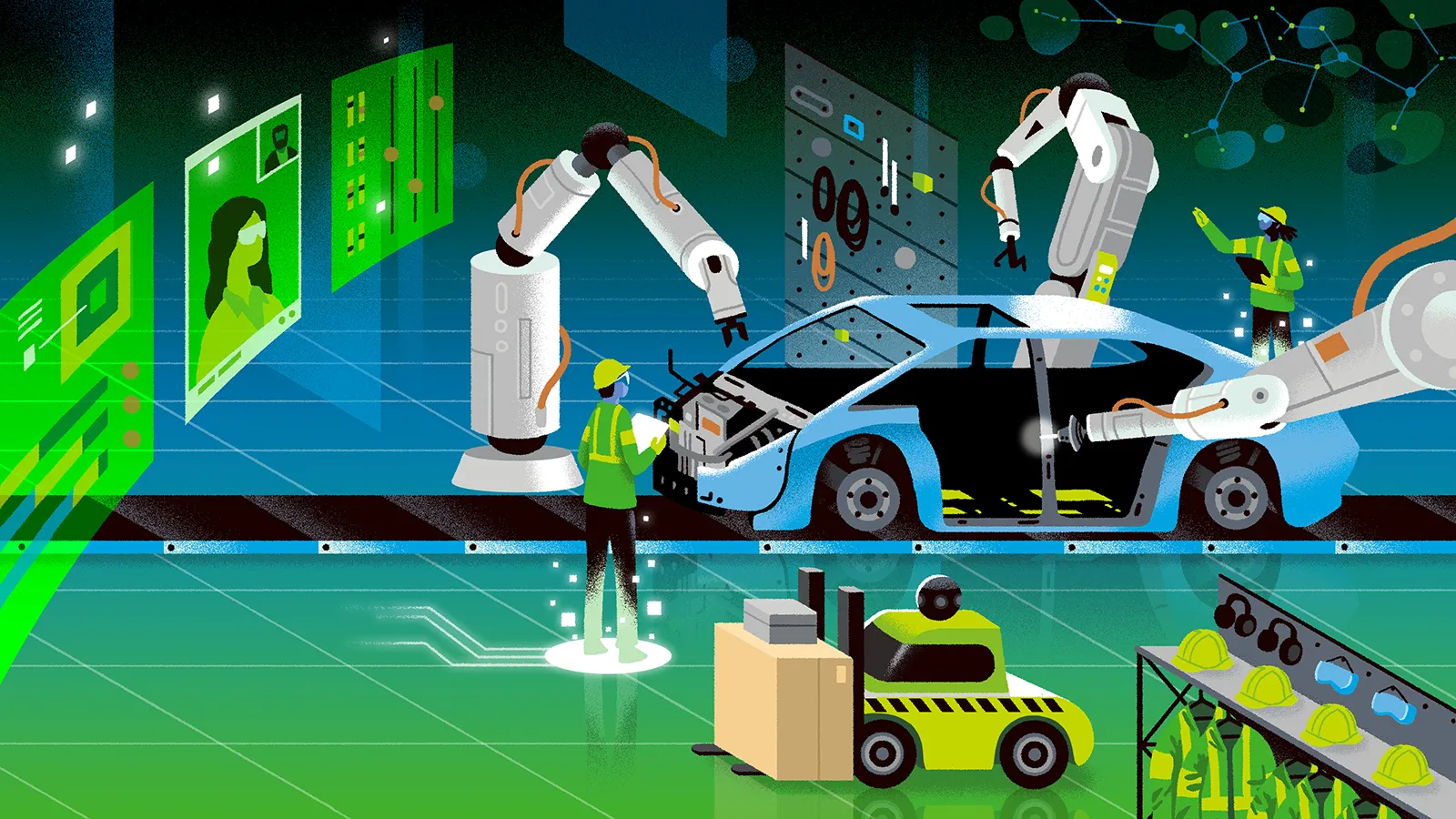
BMW has just broken ground on a new EV plant in Hungary. But instead of waiting for the physical building to be completed — what is this, the 20th century? — the company is ready to start optimizing the design ASAP.
At its peak, the factory will craft one car every minute, so the automaker doesn’t have a second to lose to inefficient assembly lines or time-consuming remodels that take the plan offline.
This is where you and your digital twin tools come in.
“Traditionally, planning something as complex as a factory has been difficult because our tools, datasets, and specialists all exist separately and are managed using a variety of systems,” says BMW Group’s Milan Nedeljković, member of the board of management. “But tools like NVIDIA Omniverse [a real-time 3D graphics collaboration platform], have allowed us to create highly detailed, virtual simulations that facilitate collaboration by anyone, anywhere.”
“Traditionally, planning something as complex as a factory has been difficult because our tools, datasets, and specialists all exist separately and are managed using a variety of systems.”
With the ability to 3D model the most efficient number and placement of each robot, storage container, assembly line, and human workstation, these digital designs produce very real savings. In fact, pre-optimizing facilities avoids costly production downtimes and is projected to lead to a 30% gain in efficiency, showing the power of extended reality (the umbrella term for AR, VR and mixed reality) and what’s possible when consultative strategy and cutting-edge tools combine.
“Extended reality can pave the way to an operationalized spatial web, where a digital layer sitting atop reality accelerates ways of working across industries,” says Mike Bechtel, Deloitte Consulting’s Chief Futurist. “By combining autonomous systems, instant 3D models, and quantum computing with optimized human involvement, we can create, say, an entire factory floor staffed by a single, well-connected worker.”
Your Factory
Now
Digital Gets Physical
who hasn’t picked up a racket
in 10 years
love of the game
AR-based products
You’re at a friend’s house for her 40th birthday party when you see a can of tennis balls on her kitchen counter. They look familiar — after all, you did play all the way through university — except for the large QR code printed on the lid.
Curious, you scan it with your mobile phone. On the screen appears Andy Murray’s mother, telling your friend she’s excited to see her back on the courts. Across Britain, other recipients receive different AR messages from the ultimate tennis mom, Judy Murray.
There in the kitchen, it all comes flooding back: the thrill of a perfectly-executed serve, the anguish of a narrow loss, the old racket you have in the garage, collecting dust. You click the link at the end of the video, and through the Lawn Tennis Association’s digital platform, you renew your LTA membership, join a local league, find an opponent of similar ability, and book a court, all within a few minutes.
The next week, you input the results of your first match. You’ve won, which boosts your World Tennis Number, a free rating system designed by the LTA for tennis players across the world.
Then, you upload the data from your wearable and get AI-generated tips about where to improve. You then book a lesson with a pro at the club, showcasing how digital tools complement human involvement.
“The spatial web era will spark new opportunities to improve efficiency, communication, and entertainment in ways we are only beginning to imagine today.”
a-game is
now at hand











LTA’s foray into AR- and AI-powered services is yet another example of our progress into the “spatial web,” which promises to eliminate the boundary between digital content and physical objects.
“By vastly improving intuitive interactions and increasing our ability to deliver highly contextualized experiences—for businesses and consumers alike—the spatial web era will spark new opportunities to improve efficiency, communication, and entertainment in ways we are only beginning to imagine today,” says Deloitte Consulting’s Chief Futurist Mike Bechtel.
For the LTA, its experience with AR and AI has been an ace. Since launching the app, the sport has become more relevant and accessible with 4.4 million adults playing each year, 700,000 children playing at least once a week, and one million fans and players registered with the organization.